
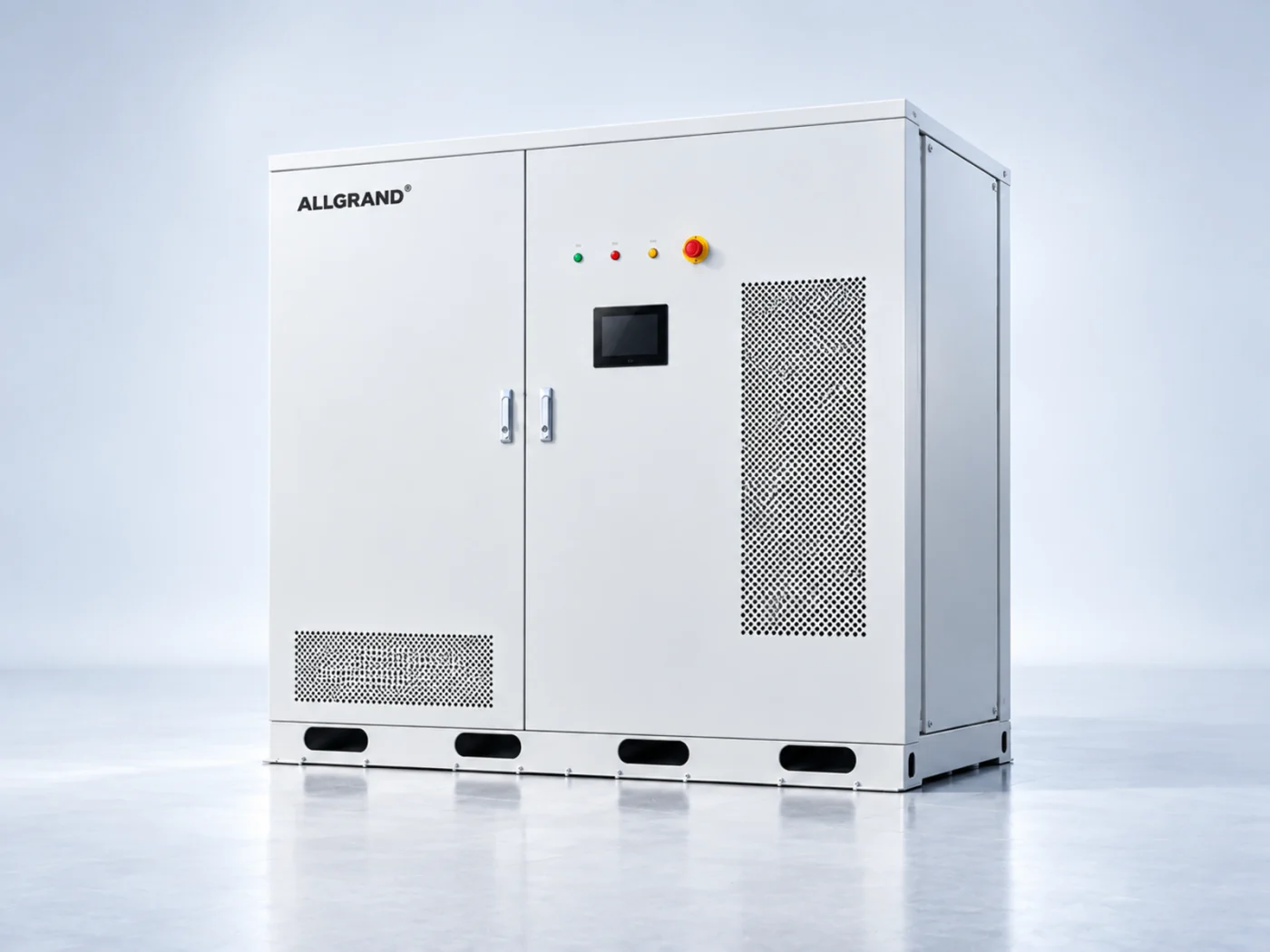
Direct answer: A BESS runtime calculation starts with the energy the load actually needs at the AC terminals, then works backward to nameplate kWh. Nameplate cell energy is reduced by approved depth of discharge, round-trip efficiency, auxiliary loads, temperature derating and end-of-life allowance. Dividing the resulting usable energy by average discharge power gives the realistic runtime. Treat the label as an input, not as deliverable energy.
Buyers often read a system as a single kWh number and assume that figure arrives at the load. In practice a 522 kWh cabinet does not deliver 522 kWh of usable AC energy over every discharge, because several losses and operating limits sit between the cells and the electrical connection. The runtime calculation exists to make those losses explicit instead of hidden.
This guide builds the conversion step by step and gives a worked example. The example is illustrative; the final depth of discharge, temperature window and end-of-life figure must be confirmed by engineering review for a specific site.
Why nameplate kWh is only a starting point
Nameplate energy is the energy stored in the cells at a defined test condition. It is usually quoted at a slow discharge, at a moderate temperature, from a full state of charge to a defined cutoff. The rating is useful for comparing cells, but it is not a promise of what the alternating-current terminals will deliver in service.
Three differences matter. First, the system does not normally cycle between one hundred percent and zero percent state of charge. Second, power conversion, wiring and the thermal system consume some of the stored energy. Third, cold ambient conditions and cell aging reduce the amount of energy the battery can release. A runtime figure that ignores these factors will be optimistic.
The usable-energy chain from cell to AC terminals
Trace energy in the direction the load sees it. Stored direct-current energy first passes through the cell’s allowable operating window, then through the direct-current path, the power conversion system and any transformer, and finally to the alternating-current connection. Along the way, five adjustments are applied in sequence:
- Depth of discharge: the fraction of nameplate energy allowed for normal cycling.
- Round-trip efficiency: the energy lost on both charge and discharge conversion.
- Auxiliary consumption: the power used by controls, pumps, fans or the heating and cooling system.
- Temperature derating: the reduced capability at low or high ambient conditions.
- End-of-life allowance: the capacity that remains after calendar and cycle aging.
Each adjustment should come from an approved operating strategy or supplier evidence, not from a marketing headline. A missing allowance is not the same as a zero allowance; it simply shifts risk onto the site operator.
The runtime formula and a worked example
Start from the energy the load requires over the outage or peak period. Then convert it to nameplate energy with a planning relationship:
Runtime (h) = usable AC energy (kWh) ÷ average discharge power (kW)
The usable AC energy is derived from nameplate energy through the five adjustments. Rearranging to find the required nameplate capacity gives:
Required nameplate kWh ≈ delivered AC kWh ÷ (depth of discharge × round-trip efficiency × thermal-auxiliary factor × end-of-life factor)
Illustrative example. A facility must supply 360 kWh to its critical loads over two hours, so the average load is 180 kW. The planning assumptions are ninety percent depth of discharge, ninety percent round-trip efficiency, ninety-five percent thermal and auxiliary availability, and ninety percent capacity at the end of the intended service period. The required nameplate energy is about 520 kWh, and the two-hour runtime is then delivered within the system’s operating limits. The load’s 180 kW average must also stay within the continuous power rating of the chosen cabinet and power conversion system.
Do not treat this result as a quotation. The actual cabinet count, parallel configuration, protection settings and control strategy must be checked together, because a bigger battery cannot correct an undersized power conversion system or an incompatible operating window.
Depth of discharge is a design decision
Depth of discharge is not a fixed property of the chemistry. It is chosen by the system designer to balance delivered energy against cycle life and reserve. A wider window yields more energy per cycle but can accelerate aging, while a narrower window preserves life at the cost of buying more nameplate capacity.
Cycle life is linked to the operating window
Cell cycle life is published for a specific depth of discharge, current and temperature. A design that cycles one hundred percent depth of discharge will not necessarily retain the published cycle count, because the cell was not tested that way. Ask the supplier for the cycle-life curve and the capacity-retention assumptions that apply to the proposed window.
Reserve for control and safety
Most commercial systems keep a small charge and discharge reserve so the battery management system can balance cells, support state-of-charge estimation and avoid over-discharge events. That reserve is part of the reason the usable window is smaller than the nameplate span.
Round-trip efficiency and auxiliary loads
Round-trip efficiency compares alternating-current energy out to alternating-current energy in over a full charge-discharge cycle. It is not a constant; it varies with load, temperature and the conversion path. A system quoted at ninety percent round-trip efficiency at rated power may behave differently at partial load, so the runtime calculation should use the efficiency that matches the site’s actual discharge pattern.
Auxiliary loads are easy to overlook because they are small relative to the battery. Over several hours, however, pumps, fans, controllers and, in cold climates, heaters consume energy that does not reach the load. In a two-hour discharge a heater that runs at several kilowatts can remove a meaningful share of the usable energy, so the calculation must account for it.
Temperature and aging change the deliverable number
Low temperature raises internal resistance and reduces the energy the cells can release at a given current. High temperature accelerates aging and can force the thermal system to work harder. A site that reads a mild average temperature may still experience cold winter mornings that matter for the worst-case outage, which is exactly the condition a backup system is meant to cover.
End-of-life allowance is the capacity the system must still deliver at the end of its service period. It should be a contract value with a defined test method. The table below shows how the five adjustments combine in the worked example.
| Step | Value | Energy after step |
|---|---|---|
| Nameplate cell energy | Starting point | 520 kWh |
| Depth of discharge (90%) | Usable window | 468 kWh |
| Round-trip efficiency (90%) | Conversion losses | 421 kWh |
| Thermal and auxiliary factor (95%) | Parasitic loads | 400 kWh |
| End-of-life factor (90%) | Aging allowance | 360 kWh delivered |
The delivered figure of 360 kWh is what supports the 180 kW average load for two hours. If any of the factors is optimistic, the runtime falls short in exactly the conditions that matter most.
Check the deliverable before comparing proposals
When two suppliers quote different capacities, convert both proposals to the same delivered-energy basis. Ask each supplier for the depth-of-discharge window, the round-trip efficiency at the expected load, the auxiliary power at the site temperature and the end-of-life capacity. A proposal that omits one of these is not necessarily wrong, but it is not yet comparable.
For a concrete system reference, the 522 kWh liquid-cooled energy storage cabinet shows how nameplate energy, power rating and thermal management are specified together. The lithium energy storage product family provides the model-level specifications from which a project-specific runtime can be built. Final values must still be confirmed by engineering review for the actual site.
Frequently asked questions
Why is my runtime shorter than nameplate kWh divided by load kW?
Because nameplate kWh includes energy you cannot use in normal operation. Depth of discharge, conversion losses, auxiliary loads, temperature and aging all reduce the energy that reaches the alternating-current terminals, so the simple division overstates runtime.
What round-trip efficiency should I use in a runtime calculation?
Use the efficiency that matches the site’s discharge rate and temperature rather than a single headline number. Request the efficiency curve from the supplier and apply the value at the load the system will actually serve during the outage or peak event.
Does a higher depth of discharge always mean more usable energy?
It usually increases energy per cycle, but it can reduce cycle life and leave less reserve for control. The correct window balances delivered energy, aging and the reserve the battery management system needs to operate safely.
How much end-of-life capacity should I reserve?
There is no universal figure. Agree the end-of-service capacity and its test method with the supplier, then size the system so the required load is still met when capacity reaches that contract threshold.
What to send for a technical review
Send the site location, ambient-temperature range, required critical load, outage duration and the fifteen-minute or one-minute load data to the AllGrand engineering team. The team can review the usable-energy chain and the preliminary runtime assumptions before quotation.
Read more energy storage engineering guides from AllGrand. AllGrand Group has manufactured batteries since 1987 and supplies energy storage systems, lead-acid batteries and battery cells to customers in more than 100 countries. Project specifications and performance values must be confirmed for the actual site and configuration.
Sources and further reading
- U.S. Department of Energy — Solar Energy and Storage Basics
- NREL — Storage Futures Study
- PNNL — Energy Storage explainer
These sources were used to verify general energy-storage concepts. The runtime sequence, calculations, worked example and acceptance criteria are original AllGrand editorial work.