
Direct answer: A battery energy storage capacity test compares measured discharge energy against a defined baseline at controlled current, temperature and state-of-charge conditions. Plan the test window, confirm the load path, record start and end conditions, then correct the result for temperature. A repeatable procedure matters more than a single pass mark, because the value of a capacity test is the trend across successive tests, not one snapshot.
A capacity test is often treated as a one-off pass or fail event, but its real value is repeatability. Without a written plan, two tests run months apart can disagree with each other more than they disagree with the original specification, and the site team cannot tell whether a drop in delivered energy is real degradation or simply a change in how the test was run.
This guide describes how to plan and record a capacity test so the result is comparable from one year to the next. The procedure is a planning reference; the exact limits, rest times and correction method must follow the equipment documentation and the supplier’s engineering guidance.
Define the test conditions before the test day
The measured capacity of a battery depends on the conditions under which it is discharged. Fixing these conditions in advance is what makes one test comparable with another. At minimum, record the starting state of charge, the discharge current or power, the ambient and cell temperatures, the end-of-discharge voltage or cutoff, and any rest period before the test.
Each of these inputs changes the result. A test started from ninety percent state of charge will deliver less energy than one started from one hundred percent. A faster discharge will deliver less energy than a slower one because of internal resistance. A cold battery will deliver less energy than the same battery at a moderate temperature. If any of these inputs is left to the technician’s discretion, the trend becomes difficult to read.
Establish a baseline before you need one
The most useful baseline is recorded at commissioning or factory acceptance, when the system is new and its behavior is known. The baseline should include the same conditions as every future test: the discharge power, the temperature, the starting state of charge, the cutoff and the delivered energy. It should also record the measurement equipment and the firmware or control version.
A baseline recorded early protects the owner later. When a question arises about capacity fade, the site team can compare today’s result against the commissioning value under the same conditions instead of guessing whether a lower number is abnormal. For a new installation, request the baseline test as part of commissioning so it exists before warranty or performance discussions begin.
The test procedure step by step
Write the procedure as a sequence the site team can follow the same way every time. The steps below form a generic flow that the equipment documentation will make more specific.
Prepare the system
Confirm the system is healthy, clear any active alarms, and bring the battery to the agreed starting state of charge. Stabilize the temperature as far as practical and record it at the start. Verify that the load bank, power conversion system or any other discharge path is available and configured for the test power.
Run the discharge and record
Start the discharge at the defined power, then record voltage, current, energy and temperature at fixed intervals until the end condition is reached. Capture the exact cutoff condition, the total delivered energy and the time. Record anything unusual, such as a protective trip, a balancing event or a change in auxiliary load, because these events explain anomalies in the data.
| Check | Acceptance evidence | Common gap to catch |
|---|---|---|
| Starting state of charge | Recorded value at test start | Assumed full without verification |
| Discharge power | Fixed value held for the test | Power drifts during the run |
| Temperature | Ambient and cell values logged | No temperature correction applied |
| End condition | Defined voltage or SOC cutoff | Test stopped early by hand |
| Measurement | Calibrated meter or system log | Energy read from a display only |
The checklist is the part of the plan that prevents small omissions from turning a useful test into a number nobody can interpret six months later.
Correct results for temperature and current
Capacity is temperature dependent, so two tests run at different temperatures are not directly comparable even when everything else is identical. Apply the supplier’s temperature correction, or record the temperature and report the result as measured at that condition. The important rule is consistency: never compare an uncorrected cold-weather result with a warm-weather baseline.
The same applies to discharge current. If the test is run at a different power than the baseline, the result must be normalized using the battery’s published rate behavior, or the difference must be stated. A small change in method can look like a large change in capacity if it is not documented.
Read the result as a trend, not a single number
One capacity test tells you the measured energy under one set of conditions. The useful signal is the trend across tests: a slow, steady reduction is consistent with normal aging, while a sudden step change suggests a fault, a configuration change or a failed correction. Investigate step changes before scheduling expensive intervention.
Compare each new result against the baseline and against the previous test. If the system has a published end-of-life threshold, track how quickly the measured capacity approaches it. The slope of that line is far more valuable than any single pass or fail label.
Keep records and set a repeat interval
Store the test plan, the raw data, the corrected result and any photographs or screenshots in one place. Name the files with the site, system and date so future teams can find them. Set a repeat interval that matches the system’s duty: a system in daily cycling service may justify an annual test, while a standby system may be tested at commissioning and after major events.
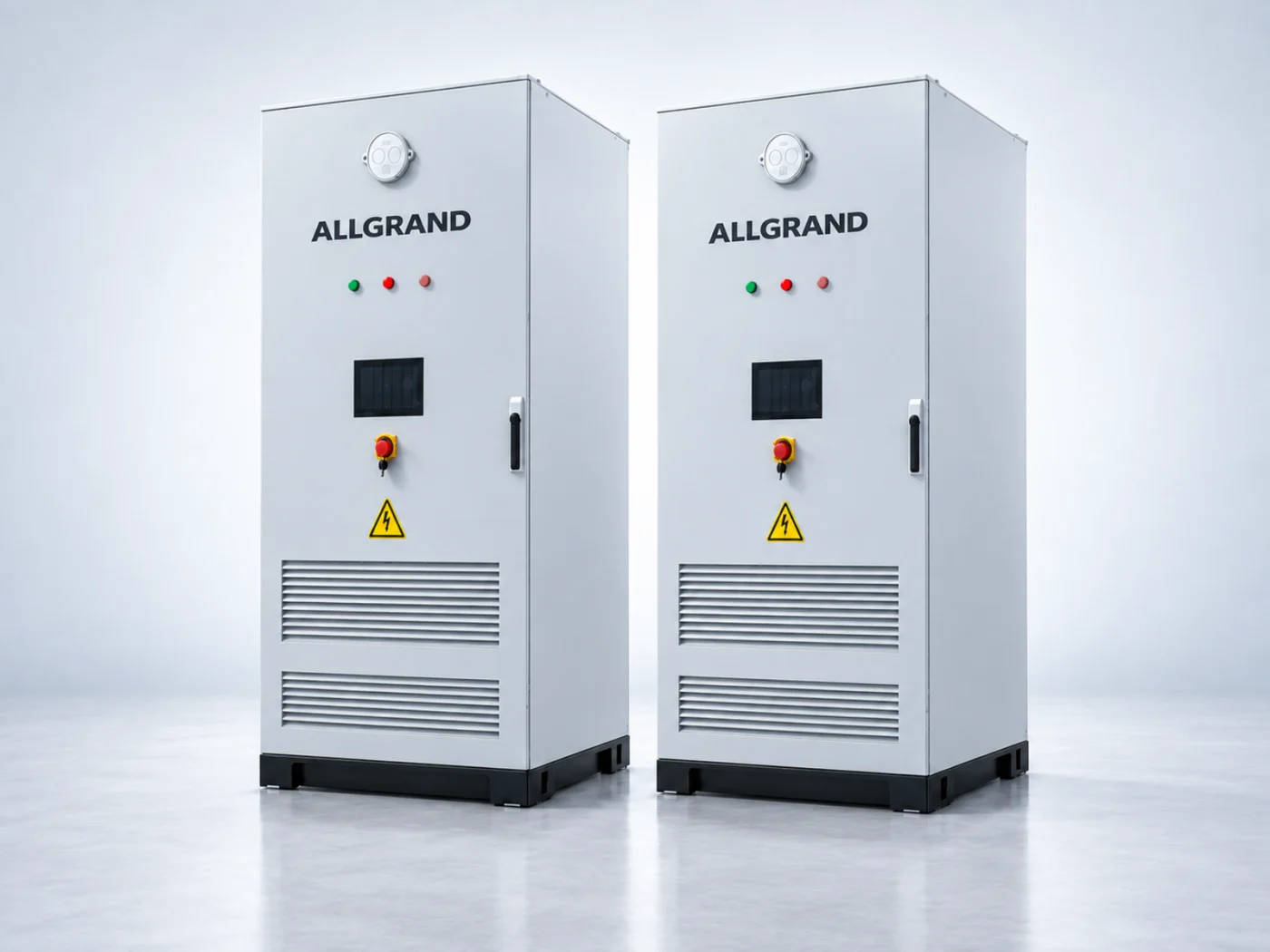
For a specific system to plan against, the 261 kWh liquid-cooled energy storage cabinet provides a defined platform for which a baseline and repeat test can be documented. The lithium product family gives the model-level specifications that a test plan references. The final procedure, correction method and interval must be confirmed with the supplier for the installed configuration.
Frequently asked questions
When should the first capacity test be run?
At commissioning or factory acceptance, so the site has a reference value before any degradation is expected. A baseline recorded early lets later tests be compared under the same conditions instead of against a data-sheet number alone.
Why does a faster discharge give less energy?
Internal resistance converts part of the stored energy into heat, and that loss grows with current. A higher discharge rate therefore delivers less usable energy at the terminals than a slower discharge, which is why the test power must be fixed and recorded.
How is temperature handled in a capacity test?
Record the ambient and cell temperature, then correct the measured energy to a reference temperature using the supplier’s method. If no correction is available, report the result at the measured temperature and never compare it directly with a different-condition baseline.
What does a sudden drop in tested capacity mean?
It often indicates a fault, a configuration change, a failed temperature correction or a measurement error rather than normal aging. Investigate the event log, the test setup and the auxiliary systems before attributing the drop to the cells.
What to send for a technical review
Share the site location, expected daily cycles, operating schedule, ambient-temperature range and any existing test records with the AllGrand engineering team. The team can review the test conditions and baseline approach for the installed system.
Read more energy storage engineering guides from AllGrand. AllGrand Group has manufactured batteries since 1987 and supplies energy storage systems, lead-acid batteries and battery cells to customers in more than 100 countries. Test limits and correction methods must be confirmed for the actual product and configuration.
Sources and further reading
- Sandia National Laboratories — Energy Storage
- PNNL — Energy Storage explainer
- NREL — Storage Futures Study
These sources were used to verify general energy-storage testing concepts. The test procedure, checklist and interpretation guidance are original AllGrand editorial work.