
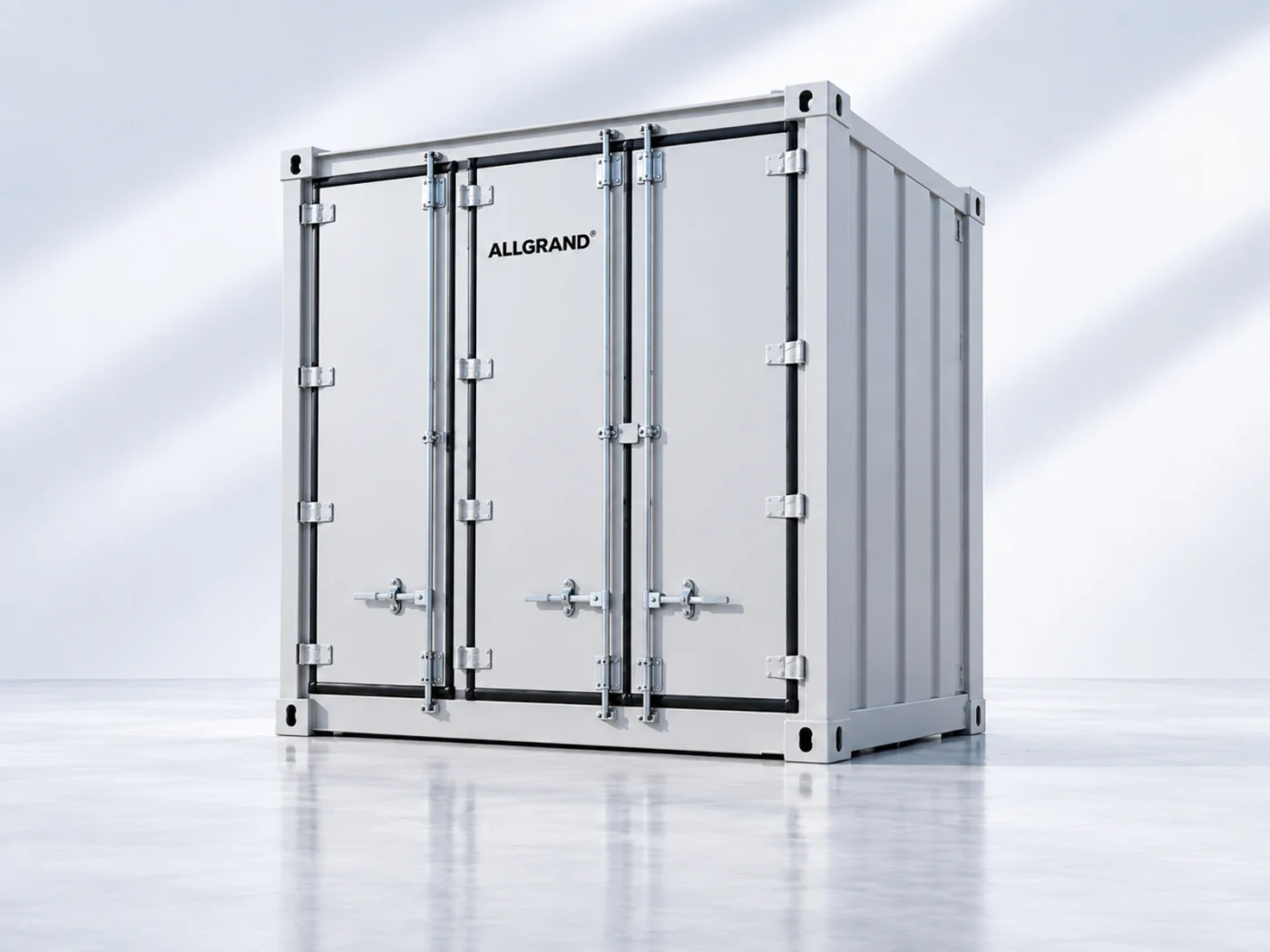
Direct answer: Compare commercial battery energy storage system suppliers on a written project scope, not on a headline price per kWh. Ask who owns each AC and DC interface, which operating conditions the capacity and power figures assume, what safety and factory-acceptance evidence will be delivered, how end-of-life capacity is guaranteed, and which assumptions sit behind the commercial offer. The answers should be traceable in the technical documents that form part of the contract.
A commercial BESS is assembled from battery racks or cabinets, power conversion equipment, thermal management, controls, protection and fire-safety measures. Suppliers can have very different boundaries around those elements. One quotation may include a complete containerised system; another may cover only DC battery equipment. Comparing the two only by nominal kWh creates an unreliable result.
This guide provides a due-diligence sequence for EPCs, integrators, distributors and end users evaluating a supplier. It is a procurement checklist, not a substitute for project-specific electrical design, utility review or local compliance assessment.
1. Fix the battery system boundary before comparing price
Start with a one-page scope drawing. Mark the grid connection, transformer, AC switchgear, power conversion system (PCS), DC bus, battery cabinets, energy management system (EMS), building management interface and communications gateway. State which party supplies, installs, commissions and warranties each item.
A battery-only supplier can be the correct choice when the buyer already has an experienced integrator. It is the wrong comparison when the project expects one party to deliver a complete grid-interactive system. The supplier should state whether the offer includes PCS, EMS, thermal management, fire detection and suppression, auxiliary power, and the control logic that coordinates them.
Define the battery boundary in voltage and location terms as well. If the supplier’s scope ends at battery terminals, specify the DC voltage window, current limits, pre-charge sequence and communication protocol expected by the PCS. Those requirements belong in the technical annex before shipment.
2. Reconcile nameplate, usable and delivered energy
Nameplate capacity usually describes the installed cell energy under stated conditions. It is not the same as AC energy delivered to the load. Ask the supplier to show the calculation from nameplate kWh to usable AC kWh, including depth of discharge, round-trip efficiency, auxiliary consumption, temperature derating and the end-of-life capacity allowance.
Then ask for the test conditions. A capacity figure can be misleading if it is defined at a favorable temperature, a low rate or the beginning of life while the project needs a higher duty and a long service life. Request the continuous power rating at the project’s expected ambient temperature and the duration at that power.
Use one consistent calculation for every bidder. If bidder A states DC usable energy and bidder B states AC delivered energy, normalize both to the same point before comparing prices. The supplier should also identify which values are guaranteed, measured, modeled or illustrative.
| Metric | Question to the supplier | Evidence to request |
|---|---|---|
| Power | What continuous kW is available at the site temperature? | Rating table, derating basis, thermal test data |
| Energy | Is the value nameplate, DC usable or AC delivered? | Capacity calculation and test conditions |
| Duration | Does the stated duration hold at the required power? | Power-energy curve and auxiliary load estimate |
| Degradation | What capacity remains at end of the guarantee period? | Warranty formula, throughput limit and test basis |
| Availability | Which outage exclusions apply? | Service agreement and reporting method |
Do not accept a single number without its unit, measurement point and operating assumption. The same battery can have several legitimate capacity values depending on those definitions.
3. Verify electrical, communications and control interfaces
Ask for an interface responsibility matrix. It should identify the owner of the DC voltage window, contactor sequence, isolation points, protection settings, communications timeout and safe-state behavior. The matrix should cover the BMS-to-PCS link, PCS-to-EMS link and any connection to a utility, SCADA or building management system.
Request a register map with data type, scale factor, unit and update rate for critical signals. Confirm whether communication loss causes a hold, ramp or trip, and who tests that response. A protocol name such as Modbus or CAN is not enough; the exact register definition and version must be frozen.
For C&I projects, space and service access are also interface issues. Confirm cable entry, turning radius, door clearance, lifting points, ventilation, separation distances and the maintenance path around the equipment. A nominally compact product can still fail site fit once those requirements are included.
4. Examine fire-safety and compliance evidence within its exact scope
Request a document list rather than a verbal assurance. Relevant evidence can include cell and module test reports, enclosure or system testing, electrical protection documentation, fire detection and suppression design, and factory quality records. The exact requirements depend on the destination market, authority having jurisdiction and installation type.
Check the model and configuration covered by each certificate or report. A component certificate does not automatically prove that a complete containerised system with a different enclosure, PCS or suppression arrangement is certified. Ask the supplier to map each claim to the product, configuration and test scope that generated it.
The fire strategy should explain detection, shutdown, isolation, suppression and emergency response as a sequence. Ask how auxiliary power, communications and remote alarms behave during a fault. Confirm which functions are factory-tested and which depend on site integration.
5. Review manufacturing control and factory acceptance testing
A credible supplier should be able to describe traceability from incoming cells and modules through assembly and end-of-line testing. Ask for the factory acceptance test plan before placing the order. The plan should list the inspection points, test conditions, acceptance criteria, witness options and records that will travel with the equipment.
Check whether the battery, PCS, controls and thermal system are tested together or separately. A functional test of individual components does not demonstrate that the complete control sequence works. For an integrated system, include communication, interlock, alarm, trip and restart scenarios in the factory test.
Manufacturing evidence should remain useful after delivery. Request serial-number mapping, firmware versions, configuration backups and the change-control process. If a module or control board is replaced, the supplier should be able to show which configuration and compatibility rules apply.
6. Read the performance guarantee and service assumptions together
Capacity, availability, efficiency and cycle-life statements need definitions. Ask what operating profile, temperature, state-of-charge range and annual throughput the guarantee assumes. Confirm the measurement method and what happens if capacity falls below the agreed curve.
The commercial offer should separate equipment price, commissioning, freight, spare parts, remote monitoring, preventive maintenance, extended warranty and on-site labor. These items can change the comparison substantially. It is also reasonable to ask which services can be performed locally and which require the supplier’s specialist team.
Check the spare-parts and firmware support period. A long equipment warranty is less useful if a critical control module or battery component is unavailable. Ask for the supplier’s escalation path and expected response time for remote diagnostics and site support.
7. Use the 12 supplier due-diligence questions
| # | Question | Evidence |
|---|---|---|
| 1 | What exactly is included in the BESS scope? | Scope drawing and responsibility matrix |
| 2 | Who owns the AC and DC interfaces? | Interface list and protocol definitions |
| 3 | Is the kW rating continuous at site temperature? | Rating and derating table |
| 4 | Is the kWh figure nameplate, usable or AC delivered? | Calculation and test basis |
| 5 | What end-of-life capacity is guaranteed? | Warranty curve and throughput limit |
| 6 | Which safety evidence covers this configuration? | Certificate or report scope matrix |
| 7 | What is the fire response sequence? | Detection, shutdown and suppression design |
| 8 | What factory tests will be witnessed? | FAT plan and record template |
| 9 | How are cells and modules traced? | Serial mapping and quality records |
| 10 | What happens after a communication loss? | Safe-state and timeout specifications |
| 11 | Which services are included for five years? | Service scope and response terms |
| 12 | Which assumptions drive the quoted price? | Commercial clarification schedule |
Send the same checklist to every bidder and require written answers. A short response that omits a critical item is more useful than a polished brochure that never addresses it, because the omission can be resolved before contract award.
8. What to send for a supplier and system review
Provide the site country and utility context, one-line electrical architecture, interval load data, required continuous kW, outage duration, expected annual cycles, ambient conditions, available installation area and target delivery date. Add any local certification or interconnection requirements known at this stage.
For a commercial container or cabinet project, compare the 1044 kWh containerised energy storage system, the 522 kWh liquid-cooled cabinet and the 261 kWh cabinet against the same normalized requirements. The correct architecture depends on capacity, redundancy, transport, site access and utility constraints rather than nominal kWh alone.
Share the project inputs and first-pass architecture with the AllGrand engineering team. The team can review the product scope, interfaces and technical questions that should be resolved before an RFQ is finalized.
AllGrand Group has manufactured batteries since 1987 and supplies lithium energy-storage systems, gel and lead-acid batteries, sodium-ion cells and LFP cells for commercial and industrial projects. Final configurations, certifications and guarantees must be confirmed for the exact product and destination market.
Frequently asked questions
How should I compare BESS prices from different suppliers?
Normalize the scope and the performance basis first. Confirm whether the price covers a battery only, a complete AC-coupled system or installation and commissioning. Then compare AC delivered energy, continuous power at site temperature, guarantees and service scope using one common calculation.
Is a lower price per kWh always better?
No. A lower nominal kWh price can exclude PCS, EMS, thermal equipment, fire protection, freight or commissioning. It can also assume a favorable operating condition that the site cannot achieve. The useful comparison is total project scope and guaranteed delivered performance.
What certifications should a commercial BESS supplier provide?
The required evidence depends on the destination market, installation type and authority having jurisdiction. Ask for the exact certificates and test reports that cover the proposed configuration, and verify the model, enclosure, components and intended use listed in each document.
Which factory acceptance tests should be witnessed?
At minimum, review electrical continuity and insulation checks, protection and interlock tests, communication behavior, alarm and trip sequences, auxiliary systems and a controlled charge-discharge test. For integrated systems, test the battery, PCS, EMS and thermal controls together.
What information does AllGrand need for a preliminary system review?
Send the application, site country, nominal voltage, load profile, required power, backup duration, expected cycles, ambient conditions, installation space and target delivery date. The engineering team can then identify the suitable product family and the remaining design questions.
Sources and further reading
- U.S. Department of Energy — Solar Energy and Storage Basics
- NREL — Storage Futures Study
- PNNL — Energy Storage
These sources informed the general concepts of storage performance, integration and project evaluation. The due-diligence sequence and tables are original AllGrand editorial work and should be adapted to the actual project requirements.