
Direct answer: Size a commercial battery energy storage system by matching a time-stamped load profile to required power in kW, delivered energy in kWh and outage autonomy. Convert delivered energy into nameplate capacity using approved depth of discharge, round-trip efficiency, temperature derating and an end-of-life capacity allowance. Then verify the design against the grid interface, available footprint, safety requirements and supplier performance guarantee.
A BESS is not a single product that can be selected from a capacity table alone. The useful unit for a proposal is a set of operating conditions: the highest demand, the energy needed during a defined event, the number of cycles, the site temperature and the point at which the system must stop delivering power.
This guide gives buyers a defensible sizing sequence and a checklist for comparing proposals. The worked example is illustrative. Final capacity, voltage, protection and warranty terms require project-specific engineering review.
1. Build a load profile that describes the real site
Start with measured interval data rather than an annual electricity bill. A 15-minute profile is often useful for demand-charge analysis, while short outages, motor starts and switching events may require one-minute or sub-minute data. The profile should cover normal weekdays, weekends, seasonal peaks and any unusual operating condition that the system must support.
Separate the loads that can be supported by the BESS from those that must be shed. A site may have 800 kW of connected load but only 340 kW of critical load during a grid outage. Sizing the complete facility for full backup can produce a system far larger than the operational requirement.
| Input | Why it changes the design | Evidence to request |
|---|---|---|
| Interval load profile | Determines peak power, energy and cycling pattern | CSV with timestamp, units and channel description |
| Critical-load list | Defines what the system must carry and what may be shed | Single-line diagram and operating sequence |
| Outage autonomy | Converts power demand into usable energy | Required hours and worst-case starting conditions |
| Ambient conditions | Affects thermal headroom, charging limits and aging | Monthly dry-bulb range and installation exposure |
| Grid interface | Sets voltage, protection, export and dispatch constraints | Utility interconnection documents and site drawings |
| Footprint and access | Limits cabinet count, clearances and service routes | Survey, structural data and lifting plan |
A measured profile also exposes duration. Ten short peaks may require more power capability but less stored energy than a six-hour outage that occurs once each month. Combining those services without checking whether they overlap can create a system that is oversized for one objective and undersized for the other.
2. Separate power, energy and duration
Power, measured in kW, is the rate at which the system can deliver or absorb electricity. Energy, measured in kWh, is the amount available over time. A simple relationship is:
Duration (h) = usable energy (kWh) ÷ average discharge power (kW)
A system rated for 250 kW and 522 kWh has a nominal energy-to-power ratio of roughly 2.09 hours at full power, but that does not mean every site receives 522 kWh through the AC terminals for exactly 2.09 hours. The limits of the PCS, battery operating window, thermal system and control strategy all matter.
For procurement, require both a power guarantee and an energy guarantee. Ask when each value applies: at the beginning or end of warranty, at what temperature, with what auxiliary consumption and at which point in the state-of-charge window. A proposal that lists one glossy capacity number without these conditions is difficult to compare with another supplier’s proposal.
3. Convert delivered energy into nameplate capacity
Design from the energy that must reach the load. Then account for the losses and margins between the cell and the electrical connection. A practical planning relationship is:
Required nameplate kWh ≈ delivered AC kWh ÷ (depth of discharge × round-trip efficiency × thermal/auxiliary derating × end-of-life capacity factor)
Each term must come from an approved operating strategy or supplier evidence. Depth of discharge is not automatically the same as the published cycle-life test condition. Round-trip efficiency changes with load, temperature and conversion path. Auxiliary power is consumed by thermal management, controls and other equipment. End-of-life capacity must be agreed as a contract value, not inferred from a marketing headline.
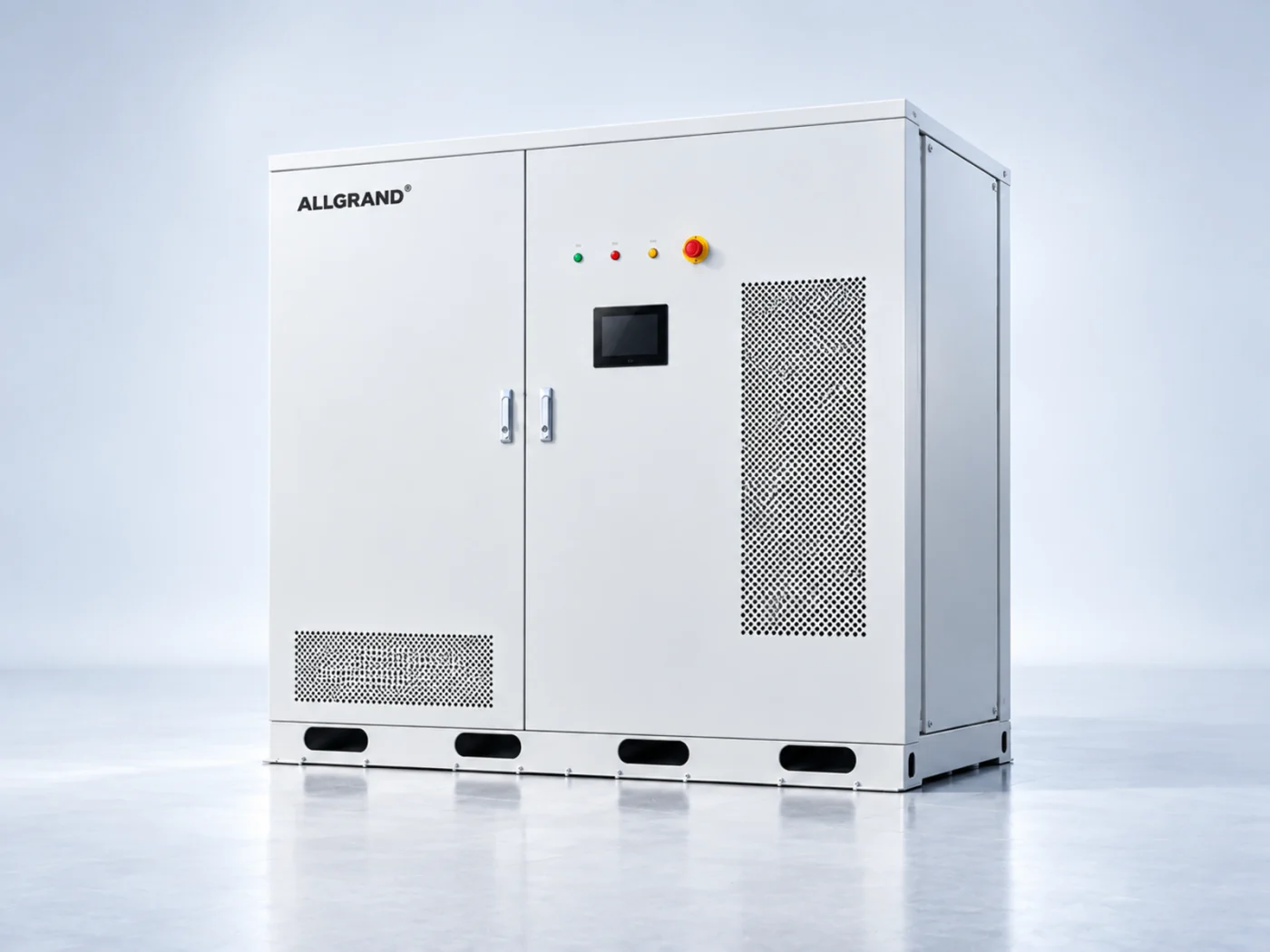
Illustrative calculation. Suppose a facility needs 700 kWh delivered to its critical loads during an outage. Planning assumptions are 90% usable depth of discharge, 90% round-trip efficiency, 95% thermal and auxiliary allowance, and 90% capacity at the end of the intended service period. The calculated nameplate requirement is about 1,011 kWh. Two published AllGrand 522 kWh cabinet models provide 1,044 kWh of nominal capacity and 500 kW of combined nominal power when the parallel arrangement is approved for the project. The site’s 340 kW peak remains below that power rating in the planning case.
Do not mistake the result for a final quotation. Cell capability, HVAC design, fire protection, enclosure rating and the approved PCS operating envelope must be checked together. A larger battery cannot compensate for an undersized thermal system, an incompatible DC voltage window or a control strategy that cannot follow the load.
4. Check C-rate and component compatibility
C-rate describes power relative to energy. A 0.5C discharge would empty a 1,000 kWh battery at 500 kW in nominal two-hour terms. This shorthand is useful for early screening, but the actual limit may be set by the cells, module temperature, BMS current limit, fuses, busbars, PCS or the connection to the facility.
Look for the continuous rating, time-limited overload rating and recovery time. A system described as capable of a high short-duration output may not sustain that output for a motor-start sequence or an extended grid event. If the site has frequent load steps, ask for the ramp rate and transient response, not only a single C-rate figure.
Trace the complete energy path. Battery voltage range must overlap the PCS window; conductor and protection ratings must cover the intended current; and the PCS, EMS and BMS must agree on control authority. These interface details are especially important when the battery, transformer, switchgear or PCS come from different suppliers.
5. Qualify the site and grid interface before comparing price
A commercially attractive cabinet can fail feasibility when it cannot fit through the access route, meet the required separation distance or satisfy the utility’s protection settings. Complete a site survey and interconnection review in parallel with sizing.
- Confirm indoor or outdoor installation, floor loading, flood exposure, seismic requirements and lifting access.
- Check the available footprint against service clearances, not only the cabinet outline.
- Define grid voltage, phase configuration, fault level, transformer size and earthing arrangement.
- Confirm whether export is permitted and whether the utility limits power injection or requires specific control behavior.
- Identify the fire-detection, suppression, ventilation and emergency-response requirements that apply in the project jurisdiction.
For containerized or utility-facing systems, the interconnection study can influence more than the battery selection. It may affect transformer impedance, protection coordination, metering and the PCS control mode. Review the 1044 kWh containerized AllGrand system only after the site and grid requirements are clear enough to define a meaningful architecture.
6. Ask for performance evidence, not only a data sheet
A supplier should be able to explain how the guaranteed capacity was derived and how it will be tested. Request the test conditions, instrumentation, voltage definition, auxiliary-load treatment and allowed measurement uncertainty. For safety and compliance, ask for the exact standards, report references, revisions and scope that apply to the proposed configuration.
| Check | Acceptance evidence | Common gap to catch |
|---|---|---|
| Load and duty case | Signed design basis with load profile and critical-load list | Annual kWh used as though it were an outage profile |
| Power and energy guarantee | Beginning- and end-of-warranty values at defined conditions | Nominal cell capacity presented as AC energy |
| Thermal design | Heat-load calculation, operating range and derating logic | No allowance for high ambient or auxiliary consumption |
| Electrical interface | Detailed single-line diagram, voltage window and protection | Battery and PCS assumed compatible without review |
| Safety and compliance | Applicable reports, installation assumptions and authority approvals | Standard name listed without product or scope evidence |
| Delivery and commissioning | Factory test plan, site test plan, roles and witness points | Capacity verified only with a short functional run |
| Service and spares | Response model, maintenance plan, monitoring and critical spares | Warranty excludes the most likely service costs |
AllGrand’s 522 kWh liquid-cooled energy storage cabinet combines its published 250 kW power rating, thermal management and fire suppression in an outdoor cabinet format. Buyers should still compare the proposed configuration, utility requirements and service scope as project deliverables. A published product specification is a starting point for engineering, not the final project guarantee.
7. Compare lifecycle cost and service scope
The lowest purchase price is not necessarily the lowest project cost. Build a comparison around the delivered service: how many cycles are available inside the agreed temperature and state-of-charge window, what happens when capacity reaches the warranty threshold, and who is responsible for troubleshooting, spare parts and software support.
Include the costs of foundations, transformers, switchgear, protection studies, communications, installation, commissioning and grid approvals. Ask whether the supplier’s scope ends at the battery terminals or includes the complete operating system. Then require a clear boundary for every interface. Most disputes appear where two suppliers each assume the other supplied a cable, control signal, protection function or acceptance test.
For a manufacturer with experience across lead-acid, lithium, sodium-ion and cell platforms, the most valuable comparison is not chemistry in isolation. It is how the selected cells, BMS, thermal system, enclosure and power electronics behave as one product over the expected duty cycle. That systems view is why AllGrand’s battery product range is organized around application and operating condition rather than capacity alone.
Frequently asked questions
How do I calculate BESS runtime from a nameplate kWh rating?
Divide the usable AC energy by the average discharge power. Usable AC energy is lower than nameplate cell capacity after depth of discharge, conversion efficiency, auxiliary consumption, temperature derating and end-of-life allowance. Confirm every assumption in the supplier’s guarantee.
Is a 1 MW battery storage system also 1 MWh?
Not necessarily. MW describes power capability and MWh describes stored energy. A 1 MW system could be designed for 1, 2, 4 or another duration in hours, depending on its intended service and equipment limits.
Which is more important for a commercial site: peak shaving or outage backup?
That depends on the load profile and business case. Peak shaving values power reduction and dispatch behavior, while backup values critical-load support and autonomy. If both are required, the design must test the combined duty case and reserve strategy.
Can two cabinets provide a larger commercial BESS?
Yes, parallel cabinet architectures can provide a modular path to higher power and energy, but the number of units, control topology, protection, thermal clearances and warranty must be confirmed as a project-specific configuration.
What to send for a technical review
Send the site location, 15-minute or one-minute load data, critical-load list, required outage duration, grid configuration, ambient-temperature range and available footprint to the AllGrand engineering team. The team can review the product architecture and preliminary sizing assumptions before quotation.
Read more energy storage engineering guides from AllGrand, or compare the full lithium energy storage product family.
AllGrand Group has manufactured batteries since 1987 and supplies energy storage systems, lead-acid batteries and battery cells to customers in more than 100 countries. Project specifications, certification scope and performance guarantees must be confirmed for the actual site and configuration.