
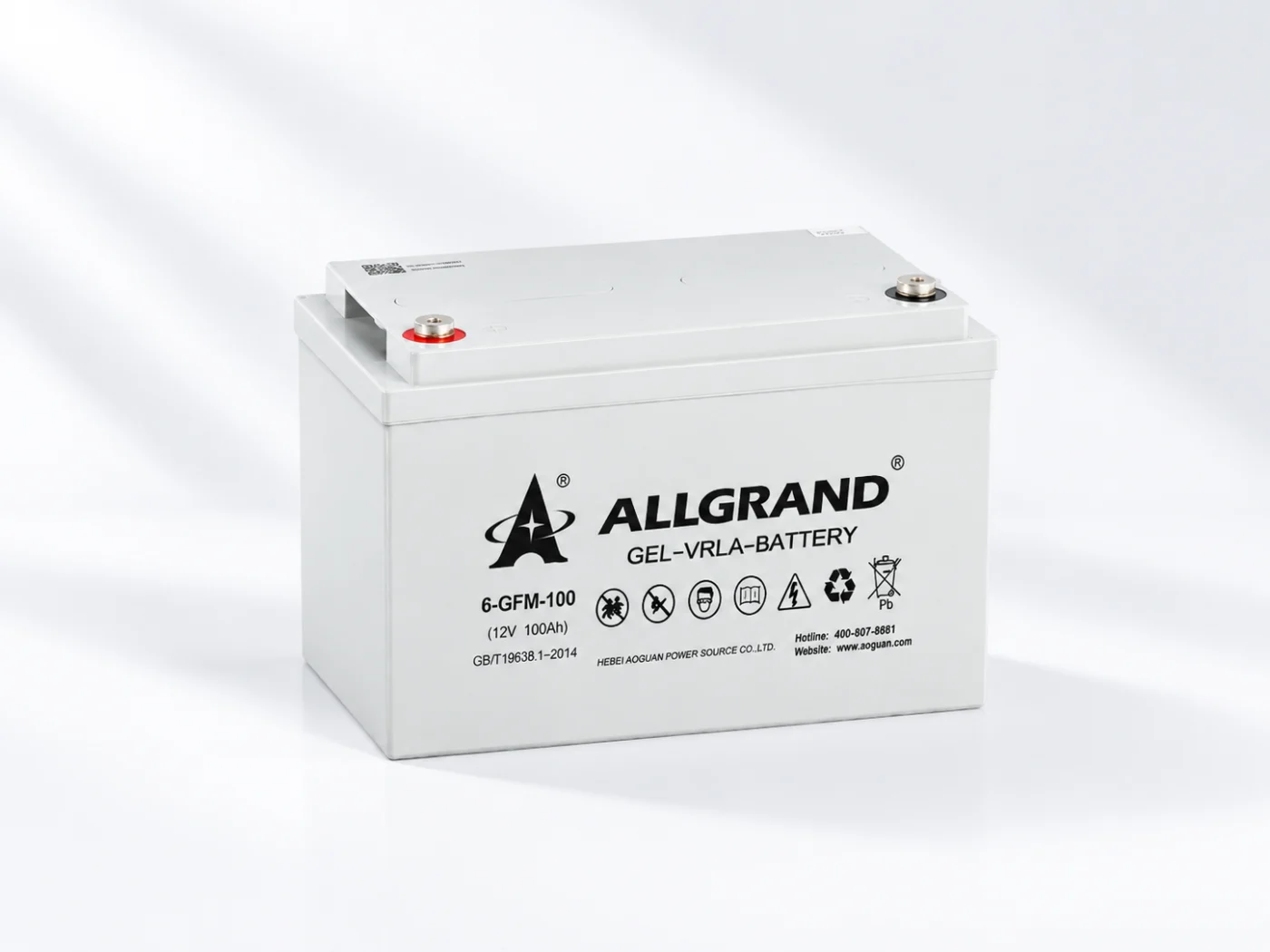
Direct answer: Gel vs AGM battery choice comes down to duty cycle and charging behavior. Gel batteries use a thixotropic electrolyte that tolerates deeper discharges and higher ambient temperatures, which suits solar and telecom sites. AGM batteries hold the electrolyte in a glass mat and deliver higher short-duration currents, which suits UPS and high-rate backup. Match the chemistry to the load profile, charger and temperature, then confirm the model datasheet.
Both are sealed lead-acid designs with no watering and similar mechanical construction. The difference appears in the electrolyte, the charging window and the way each chemistry ages under cyclic or standby duty. Buyers who treat them as interchangeable often discover the mismatch at commissioning.
Two sealed lead-acid designs on a shared platform
Gel and AGM batteries are both valve-regulated lead-acid (VRLA) products. Oxygen recombines inside the cell during normal charging, and a pressure valve releases gas only under abnormal conditions. Neither design needs electrolyte topping up, and both can be installed in cabinets or remote sites where maintenance visits are expensive.
The shared platform is why datasheet values can look similar at a glance. The differences that matter are the electrolyte structure, the acceptable charge voltage, the maximum charge current and the way the positive plate is supported. Those details decide whether a battery survives a daily solar cycle or a decade of float service.
Where gel and AGM batteries actually differ
Electrolyte and recombination
A gel battery immobilises the electrolyte with fumed silica, so the acid behaves like a paste rather than a liquid. The gel fills the space between plates and separator, which slows acid stratification and makes the cell more tolerant of partial-state-of-charge operation. An AGM battery holds the electrolyte in a glass-fibre mat. The mat provides a short, low-resistance path for high currents, but it can dry out faster if the battery is overcharged or overheated.
Charging voltage and current limits
Gel batteries generally accept a narrower charge-voltage window and a lower maximum charge current than AGM batteries of similar capacity. A charger set for AGM may push a gel battery above its recommended voltage, driving water loss and premature capacity loss. The charger profile must match the chemistry, not just the nominal voltage. Confirm float, boost and temperature-compensation settings with the model datasheet before commissioning.
Cycle life versus standby life
Gel chemistry is often selected for cyclic duty: solar storage, remote telecom sites and off-grid systems where the battery discharges and recharges regularly. AGM chemistry is often selected for standby duty: UPS, switchgear, emergency lighting and short-duration backup where the battery sits on float for most of its life and must deliver current quickly. These are tendencies, not rules; specific models differ, and the datasheet remains the reference.
Gel versus AGM at a glance
| Property | Gel | AGM | Selection impact |
|---|---|---|---|
| Electrolyte | Immobilised gel | Glass-fibre mat | Gel resists stratification; AGM favours high current |
| Charge window | Narrower, lower current | Wider, higher current | Charger profile must match chemistry |
| Typical duty | Cyclic, deep discharge | Standby, short discharge | Match to load profile, not habit |
| High-rate output | Moderate | Higher | UPS and switchgear favour AGM |
| Heat tolerance | Generally better | More sensitive to drying | Hot cabinets need a temperature review |
| Maintenance | No watering | No watering | Both need inspection and torque checks |
| Best fit | Solar, telecom, off-grid | UPS, emergency, high-rate | Confirm with the model datasheet |
When a gel battery is the better choice
Gel is worth evaluating when the battery discharges regularly, when the site is hot, or when maintenance access is limited. Solar systems with daily cycling, remote telecom cabinets and off-grid installations are common examples. The gel structure slows stratification and tolerates partial-state-of-charge operation better than a conventional flooded design, which helps when charging is irregular.
The trade-off is charge acceptance. Gel batteries cannot absorb current as quickly as AGM, so the charger and the available charging window must be sized for the duty. A system that depends on a short recharge window may need a larger battery or a different chemistry. AllGrand’s gel ranges, including the 6-GFM 12V gel battery and the GFMJ 2V pure gel battery, are published as model-level examples; project requirements must be confirmed by engineering review.
When AGM is the better choice
AGM is worth evaluating when the load is short and intense, when the battery spends most of its life on float, or when the installation needs a compact, low-resistance power source. UPS systems, switchgear, emergency lighting and high-rate backup are typical applications. The glass mat supports a high discharge current and a simpler recharge path, which shortens recovery time after a short outage.
The trade-off is thermal sensitivity. Overcharging or a hot cabinet can dry the mat and shorten service life. AGM also benefits from a charger that respects its voltage window and temperature compensation. AllGrand’s 6-GFM 12V standby battery and the wider lead-acid and gel battery range show how the two chemistries sit side by side in the catalogue.
Checks before you specify either chemistry
Use this list to turn a chemistry preference into a defensible specification:
- Write down the duty cycle: discharges per year, depth of discharge and recharge window.
- Confirm the ambient temperature range, including the hottest cabinet condition.
- Match the charger profile, float voltage and temperature compensation to the chemistry.
- Check the maximum charge current against the model datasheet, not the nominal capacity alone.
- Confirm the required short-duration current at the end-of-discharge voltage.
- Review series and parallel string limits, terminal torque and ventilation for the enclosure.
- Agree the acceptance test and the reference conditions before the order is placed.
These checks matter more than the label on the case. A gel battery on an AGM charger, or an AGM battery in an overheated cabinet, will underperform regardless of the datasheet headline.
Frequently asked questions
Is gel better than AGM for solar?
Gel is often a good fit for solar because it tolerates cyclic duty and partial-state-of-charge operation, but the charger must respect its lower current limit. AGM can also work in solar when the recharge window is adequate and the cabinet stays cool. Compare the actual load profile before choosing.
Can I charge a gel battery with an AGM charger?
Not safely without checking the profile. Gel batteries usually need a lower charge voltage and current limit. Confirm the float, boost and temperature-compensation settings against the gel model datasheet before commissioning.
Which chemistry lasts longer?
Service life depends on duty, temperature, charging and depth of discharge more than on the chemistry label. A well-matched AGM in standby service can outlast a poorly charged gel battery, and the reverse is also true. Use the datasheet and the application conditions.
Do gel and AGM batteries need maintenance?
Neither needs watering, but both need inspection. Check terminal torque, cleanliness, case condition, charging voltage and temperature, and record the readings so a drift can be traced. Follow the manufacturer’s service schedule.
What to send for a technical review
Share the load profile, required backup time, ambient temperature range, charger settings and available cabinet space with the AllGrand engineering team. The team can compare gel and AGM options against the actual duty and confirm the model-level specification. More selection guides are available in the AllGrand blog.
Sources and further reading
- IEC – Energy Storage Standards
- UL Solutions – Energy Storage
- Sandia National Laboratories – Energy Storage
These sources were used to verify general sealed lead-acid and energy-storage concepts. The selection checklist and comparison table are original AllGrand editorial work.